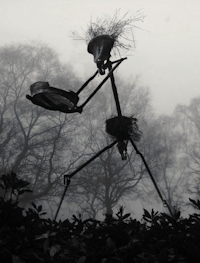
Toolmen
Because of their semi-sapient nature, Toolmen are not recommended as player-characters. They may however accompany PC's as menial companions, or be fashioned from the remains of a vanquished PC to embody them in spirit.
Toolman | |
|---|---|
| |
Details | |
| Appearance: | Mechanical, varies |
| Origins: |
Undead
Originally created by humans as a form of necromancy |
Attributes | |
| Info: | xyz |
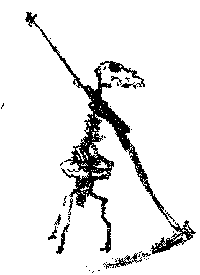
Toolmen, otherwise known as "menials," "puppets, or "jockeys," are undead mechanical servants fashioned as a form of funerary reanimation of the recently-deceased. Toolfolk are dutifully loyal to their masters, typically the bereaved family or loved ones. They are however incapable of speech or complex communication, only able to receive instructions or act on obscure intuition.
Table of Contents
Creation and origins
In human culture
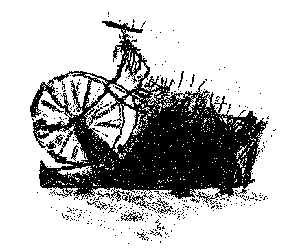
This rite of necromancy is supposedly linked to the "nail-driven"; in order to stave off an endemic plague, humans adopted the practice of driving purifying nails into infected corpses before interment. As an unintended consequence, however, some bodies buried in this way began to rise from their graves and roam aimlessly, usually attacking anyone they came across. Research eventually revealed that only those with nails deeply embedded in the bone marrow seemed to rise as driven corpses.
The ritual is complex and sensitive, usually only performed by adept shaman at the behest of the deceased's family. It involves the extraction of bone marrow from the cadaver, to be enclosed in the body and limbs of the puppet. Puppets may be constructed in a number of manners to suit their purpose, usually comprising a skeletal frame of pipes and rods, with tools or hands at the ends of the arms, and legs or wheels used for ambulation. The finished puppet is buried in a shallow grave, while the flesh of the body is discarded in whatever manner is custom, usually by cremation or sky-burial.
Humankind came to develop strict norms and taboos around necromancy. Typically, the practice is performed on those who meet an untimely death, and whose absence would imperil the lives or livelihoods of the grieving. Menials are most often seen on small farms and homesteadsl, and are of little use to those of greater means. Toolmen do not respond well to sale or forfeiture, becoming despondent when their familial ties are severed. Furthermore, the inclusion of anything resembling a human face on a puppet is considered profane, as is the incorporation of any significant amount of visible material from the cadaver (apart from hair).
In other cultures
The Ogre took an immediate liking to toolfolk, being machine-minded themselves. Human shaman happily taught the ritual to their peers among the ogre, and it is performed in much the same way as before; the key difference being in the method of disposal of unused remains. The use of toolmen quickly became indispensible to the recovering ogre civilization, as the prohibition of electricity resulted in a need for alternative ways to power their machines.
In contrast to humans, ogre are generally not individuated along familial lines. Ogre society was historically collectivist, with a marked de-emphasis of individual identity. This results in subtle differences in the behavior and treatment of ogre toolmen. Rather than operating in service to one person or family, their puppets are often shared or even incorporated into larger machines to better serve as thralls to the community. Many such toolmen lack appendages for movement, only possessing the necessary articulation to perform repetitive tasks. Because of this, the sight of an ogre menial has been known to make humans uncomfortable, as it appears to humans as subordination beyond what one would subject to a beloved member of their family. Some ogre shaman have also been known to decorate toolmen in ways that humans find grotesque.
Some gnomish shaman would seek to learn the art of necromancy from the surface-dwellers, but rarely do gnomes find use for it. Gnomes seldom travel far from their hives and are more likely to make use of beasts than they are to use menial servants. Another potential reason, it is believed that gnomes lack a sense of pareidolia, and thus have difficulty finding familiarity or kinship in toolmen.
Hostility
Dismantling
Dismantling a toolman can often be much more difficult than creating one, especially if the toolman is enraged and cannot be instructed to comply. What's more, it is not known where precisely a menial's spirit resides, and thus its release is typically a process of trial and error and may require total destruction of the puppet. Outside of emergencies, this is usually undertaken by specialists. Re-using parts of decommissioned toolmen for any purpose is never recommended.
Orphans
Toolmen seldom turn on their stewards, but cases of toolmen lashing out at humans and the like are not unheard of. Volatile behavior typically arises from lack of purpose–usually due to orphaning from their bonds–but can also result from errors in performing the rite of reanimation. A stray toolman's temperment is often difficult to ascertain due to their inability to communicate, but orphans are typically considered entirely hostile.
Tool colonies
Little is known of tool colonies, but it is rumored that orphaned toolmen gathered in close proximity may eventually begin to modify themselves and amalgamate, acting as one much larger golem of sorts. Colonies have been described as "completely inimicable" and "nigh-indestructible."